The United Nations General Assembly, in December 2000, proclaimed 22 May as ‘The International Day for Biological Diversity’, to increase understanding and awareness of biodiversity issues. Earlier December 29th was the date to observe International Day for Biological Diversity. However, it was difficult for many countries to plan and carry out suitable celebrations for the date of 29 December, given the number of holidays that coincide around that time of year. Noting the recommendation of the Conference of the Parties to the Convention on Biological Diversity at its fifth meeting that the date of the International Day for Biological Diversity be changed to give it greater visibility, it was decided to proclaim 22 May, as the International Day for Biological Diversity henceforth.

Showing posts with label Rabish Chandra. Show all posts
Showing posts with label Rabish Chandra. Show all posts
Friday, 22 May 2015

Sunday, 3 August 2014
Book Review : 'Green Wars- Dispatches from a Vanishing World' by Bahar Dutt
Tweet
Rabish Chandra
@rabishchandra on twitter
*Views are personal
As I was updated
about the release of this book a couple of months ago I looked forward to
reading this book. But later, I changed my mind to purchase this book by seeing
the inboxed images of Sarus Cranes, primates and tiger skin; as I connect myself
more to plants, trees, grass, flowers etc. Yes, you may call it as ghaans-phoos or jungle-jhaar.
Sunday, 6 July 2014
A Dialogue with Professor Judy Jernstedt about Botany and 100 years of American J of Botany
Tweet
 |
| Cover- American J Botany; 101(1) |
American Journal of Botany, was launched in 1914. Since then over a period of hundred years AJB has published approximately 16500 articles, with an average of more than 160 and 13 articles per year and month respectively. Many articles published in AJB are highly cited and are from various sub-disciplines of botany. It possess the pride of publishing many breakthrough research publication which were significant in understanding the structure, function and further advancement of mechanism in plants.
To celebrate the completion of a century and stepping forward in its second century of publication, AJB will feature monthly invited AJB Centennial Review Papers. It will also bring a special issue, 'Speaking of Food: Connecting Basic and Applied Science' which probably will consists the paper presented at colloquium during Botany-2013 Conference.
Saturday, 15 March 2014
Forensic Botany: An Emerging Discipline of Plant Sciences
Rabish Chandra* and Vinny Sharma1
*Central Excise Officer
Customs, Central Excise and Service Tax, Coimbatore, Tamil Nadu
(Views expressed herein are personal)
1Research Scholar
Department of Anthropology, University of Delhi, Delhi-110007
*Central Excise Officer
Customs, Central Excise and Service Tax, Coimbatore, Tamil Nadu
(Views expressed herein are personal)
1Research Scholar
Department of Anthropology, University of Delhi, Delhi-110007
How to cite this article
Chandra, R., Sharma, V., (2014), Forensic Botany: An Emerging Discipline of Plant Sciences. Indian Botanists Blog-o-Journal. http://www.indianbotanists.com/2014/03/forensic-botany-emerging-discipline-of.html
ABSTRACT: Various disciplines have emerged due to vast expansion in the studies of plant sciences. Discovery of new methods, protocols and analytical techniques facilitates for thorough and deep study of the given subject. One among many disciplines which has appeared as an offshoot from basic plant science is forensic botany. Forensic botany is an interdisciplinary area where the knowledge of botany is applied to solve the crime. This paper introduces about the basic of the subject explaining various sub-disciplines and its application in forensic science. It also cites some cases where botanical evidences have been the part of judgements.
Chandra, R., Sharma, V., (2014), Forensic Botany: An Emerging Discipline of Plant Sciences. Indian Botanists Blog-o-Journal. http://www.indianbotanists.com/2014/03/forensic-botany-emerging-discipline-of.html
ABSTRACT: Various disciplines have emerged due to vast expansion in the studies of plant sciences. Discovery of new methods, protocols and analytical techniques facilitates for thorough and deep study of the given subject. One among many disciplines which has appeared as an offshoot from basic plant science is forensic botany. Forensic botany is an interdisciplinary area where the knowledge of botany is applied to solve the crime. This paper introduces about the basic of the subject explaining various sub-disciplines and its application in forensic science. It also cites some cases where botanical evidences have been the part of judgements.
Saturday, 11 January 2014
Characteristic Features of Bamboo: General Botany and Physiology
Tweet
India is considered as one of the largest reserves of Bamboos in the world. (Naithani, 2008) reveal 20 genera with their 115 species of Bamboo in India. Found in the forests of almost all the states except in Kashmir valley. Constitutes around 12.8 percent of the total area of forest cover in country. North Eastern regions has over 50% of the total species occurring in India.
Monday, 9 December 2013
Arenga Pinnata offers free food and job with alcohol and energy
Rabish Chandra
@rabishchandra on twitter
National Geographic News portal published a story on this plant as a part of special series that explores energy issues. Though the news is old but its significance is always new as the whole world is looking for an alternate source of energy. The story talks about the feather palm Arenga pinnata as an important source of energy. Marianne Lavelle for National Geographic News quotes Willie Smits, a tropical forest scientists, "The deep-rooted feather palm Arenga pinnata could serve as the core of a waste-free system that produces a premium organic sugar as well as the fuel alcohol, ethanol, providing food products and jobs to villagers while it helps preserve the existing native rain forest". Find out more A Rain Forest Advocate Taps the Energy of the Sugar Palm
@rabishchandra on twitter
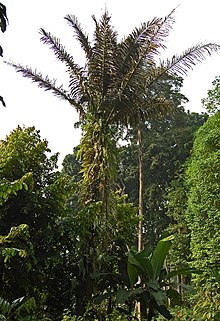 | ||
| Arenga pinnata PicCourtesy: wikipedia |
National Geographic News portal published a story on this plant as a part of special series that explores energy issues. Though the news is old but its significance is always new as the whole world is looking for an alternate source of energy. The story talks about the feather palm Arenga pinnata as an important source of energy. Marianne Lavelle for National Geographic News quotes Willie Smits, a tropical forest scientists, "The deep-rooted feather palm Arenga pinnata could serve as the core of a waste-free system that produces a premium organic sugar as well as the fuel alcohol, ethanol, providing food products and jobs to villagers while it helps preserve the existing native rain forest". Find out more A Rain Forest Advocate Taps the Energy of the Sugar Palm
In India, in the eastern part, the sap is harvested for yielding jaggery or gur. Fibres produced from this plant are highly durable, resistant to sea water and easy to
process. It goes well in agroforestry systems too. In some parts this is used in traditional system of medicine and is considered for its stomachic pectoral diuretic and atihemophilic properties.
Domestication and further exploration of this plant needs more attention.
Domestication and further exploration of this plant needs more attention.
Saturday, 13 July 2013
Traditianal Practice of Mango Plucking in Bihar, India
Tweet
Rabish Chandra
@rabishchandra on twitter
Mango is considered as 'The King of all Fruits' in India. Mangifera indica (Linn.) (scientific name for mango) belongs to family Anacardiaceae of plant kingdom. It is found wildly as well as several introduced and cultivated varities also occurs in different parts of India. India occupies top position among mango growing countries of the world and produces 40.48% of the total world mango production (APEDA, 2010).
Tuesday, 9 July 2013
Death Before Life to Dalbergia Sissoo (Shisham) : Unfolding the Mysteries
Tweet
Rabish Chandra
@rabishchandra on twitter
'What will be its life'?...I asked.
'You have to contact a wood expert for that', he said.
Wood expert!
Yes, he can only tell the life.
But, I am a botanist, I can also tell it's life. Provided if you can tell the name of the plant of which it is made.
Gentleman, as a botanist you may tell the life of a live plant, but not the dead one and the life of any timber plants is counted only after it dies.
Ok. Ok. But is not made up of Shisham? I mean Dalbergia sissoo.
Sunday, 7 April 2013
TERPENOIDS : CLASSIFICATION, PROPERTIES, ISOLATION AND APPLICATION
Terpenoids are volatile substances which give plants and flowers their fragrance. They occur widely in the leaves and fruits of higher plants, conifers, citrus and eucalyptus. The rate of discovery of new terpenoids has increased over the last ten years largely as a result of the increase in the sophistication of separation and analytical techniques.
Subscribe to:
Posts (Atom)